The business problem
A requested feature reaches production, but nobody can show which customer need it addresses or whether that need was resolved. A merged change and a successful deployment establish technical milestones; they do not by themselves establish customer value.
Design the management relationship
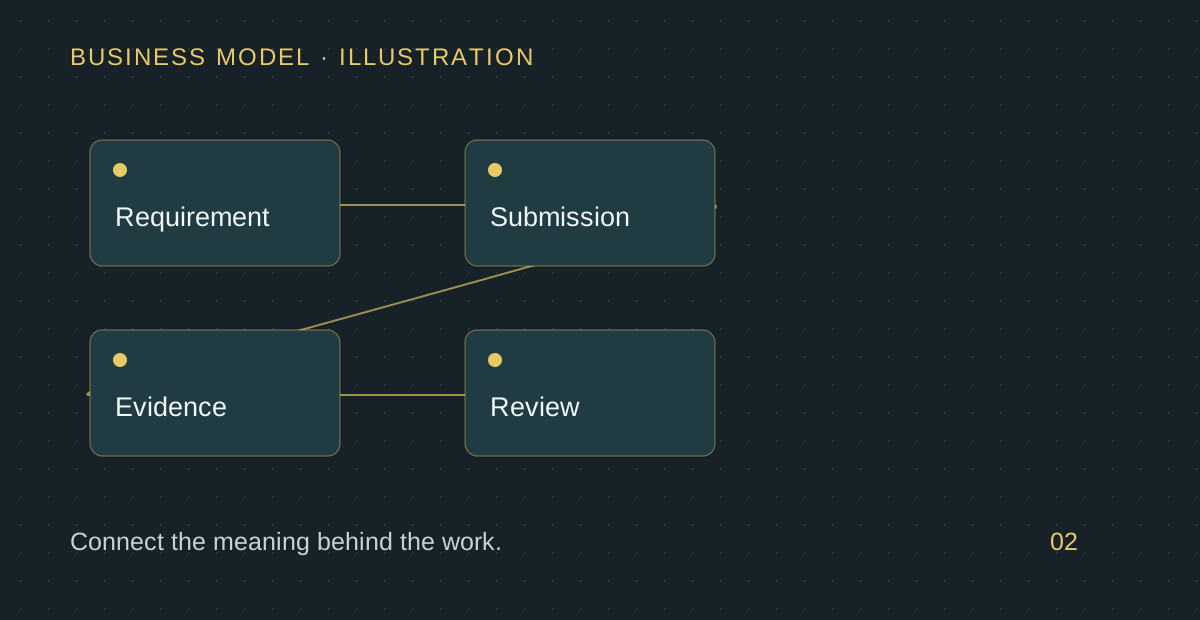
Link the original request to the agreed requirement, acceptance criteria, implementation, tests, release and production observation. When the requirement changes, preserve the earlier decision and identify which acceptance criteria must be reconsidered.
Build the structured operating model
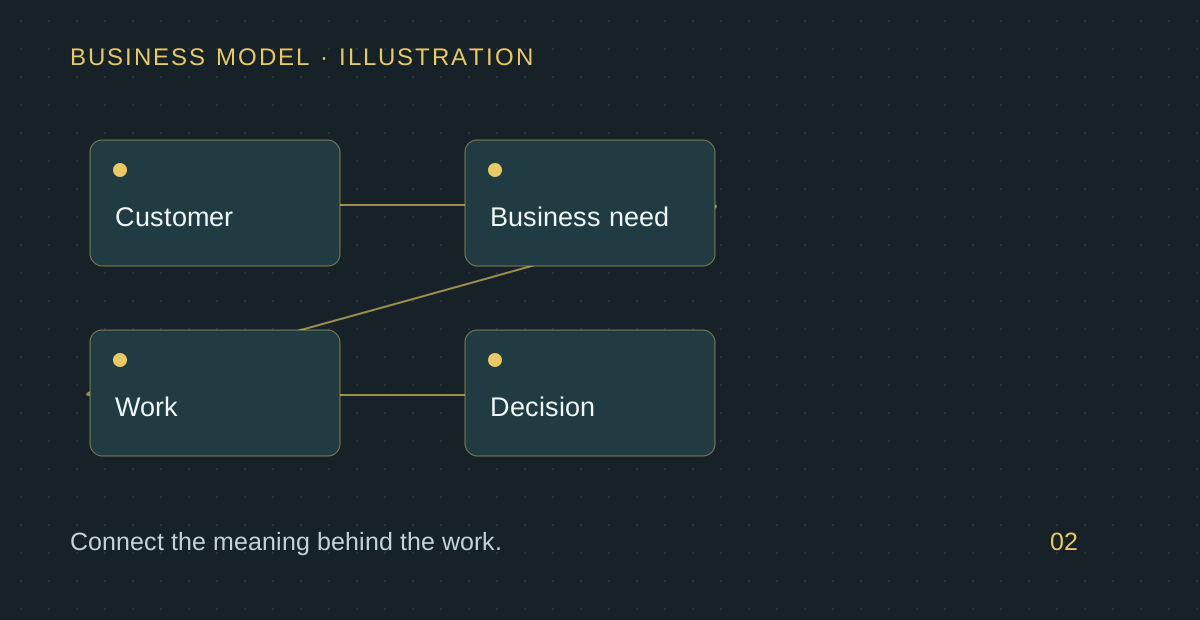
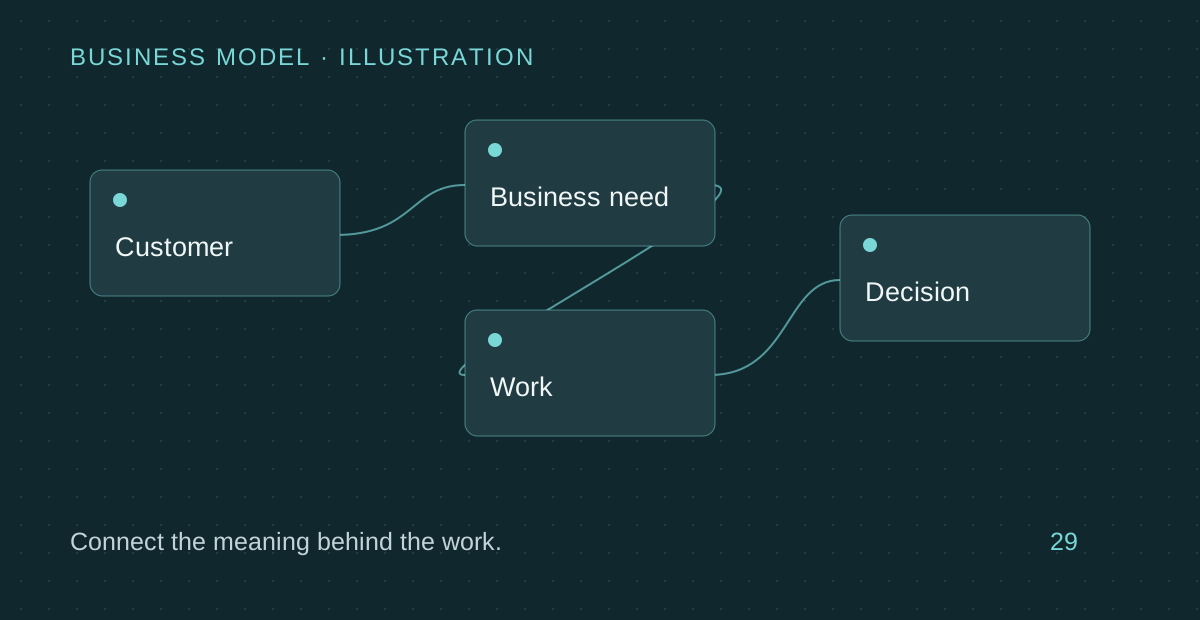
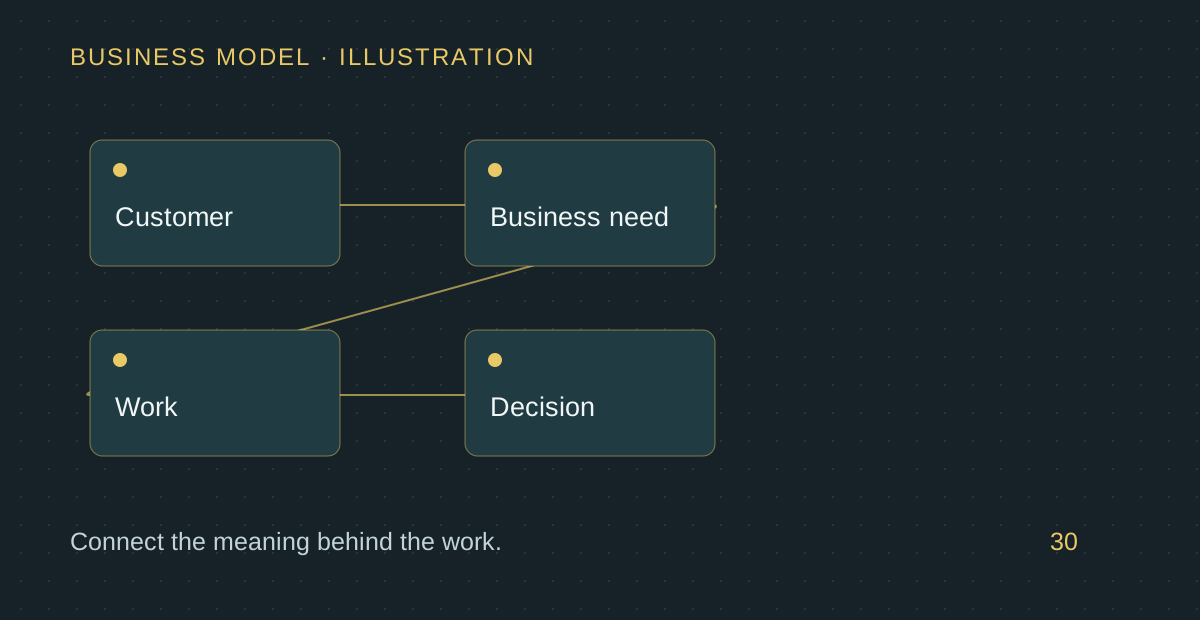
Give the customer request, interpreted requirement, acceptance criterion, implementation change, test and release separate identities. Link them explicitly, including which interpretation a customer or product owner accepted. A release event should identify the exact change and verification result rather than a loosely related project name. Where a request is revised, the relationship history should show which earlier assumptions are superseded. This allows an agent to prepare an impact analysis from connected context, while the authorized owner still decides whether the proposed change satisfies the business intent.
The decision for your role
For a CTO, the important connection is between technical action and the business reason it exists. Preserve the accepted requirement, its implementation dependencies, the tests that verify behavior and the production observation that checks the intended result. Those records should remain connected when an agent prepares code or a team changes a design. A task is not fully explained by a repository reference: the responsible engineer also needs to know the affected commitment, operating conditions and acceptance owner. Separate technical readiness from business acceptance, and record which version of a rule or requirement a test represents. When a change fails, use the relationships to distinguish misunderstood intent, implementation error, missing verification and an incorrect operating assumption. Avoid giving an AI more authority simply because it can produce a plausible implementation quickly. Start with one traceable change, test the recovery path and retain the evidence required for another team member to reconstruct the release decision without interviewing its original author.
Apply it in the operating setting
In a software business, use a customer-facing change as the reference journey. Connect the conversation to the accepted need, intended business effect, implementation, test, release and production observation. A technical milestone should not erase the original customer question. If an agent makes a change, retain the task context, authority and exact verification performed. Test what happens when acceptance fails after deployment, including who owns correction and how the customer commitment is updated. The purpose is to make software delivery part of a company-wide operating model, with both technical evidence and business judgment visible.
The operating discipline
The management value of traceability appears when a change can be followed in both directions. A business owner should be able to see the implementation and verification that address a request. A technical owner should be able to identify the business commitments affected by a proposed change. Preserve stable identities and explicit relationships across these steps. Where an automated interpretation is used, retain the original request and a human-readable explanation of the interpretation. A successful technical check and a demonstrated business outcome are related evidence, but they answer different questions.
A practical decision example
Consider a customer asking for a faster approval screen. The proposed feature is a new interface, but the original problem may be unclear authority rather than navigation. Preserve the business question while investigating the solution. Production verification should examine whether the intended approver can complete the real scenario, and whether the customer problem improves, alongside technical tests that show the interface operates correctly.
Observe, automate and verify responsibly
Before enabling an automatic action, define what the operating history must retain. A useful record identifies the actor, business object, time, reason, authority, relevant input version, observed action and resulting state. Keep a failed attempt separate from a successful retry. If the action sends an email, distinguish preparation, approval, send attempt and delivery observation; attempting to send does not prove that the recipient received or acted on it. Assign an owner for exceptions and say when a human must intervene. Then ask a colleague who was not involved to reconstruct the event using the records alone. Missing context is a model gap to resolve before increasing autonomy. This is how observability supports accountability across people, agents and connected systems, rather than becoming a large collection of unexplained technical logs.
What to test first
Choose one released feature. Ask a person outside its delivery team to reconstruct the reason, approval and observed outcome. Record missing links and the time required to answer.
What this means for Flowise
Flowise is designed around a shared company model: business purpose, relationships, ownership, and results. Start with real work, preserve the supporting evidence, and improve the model as the team learns.