The business problem
A departing specialist leaves extensive files but no explanation of which advice worked, when it applied or why alternatives were rejected. The replacement has documents yet must reconstruct the working knowledge through repeated interviews.
Design the management relationship
Capture the case, context, decision, rationale, exception and observed outcome together. Link reusable guidance to its evidence and limits. AI summaries can help retrieval, but preserving source context is what makes later interpretation possible.
Build the structured operating model
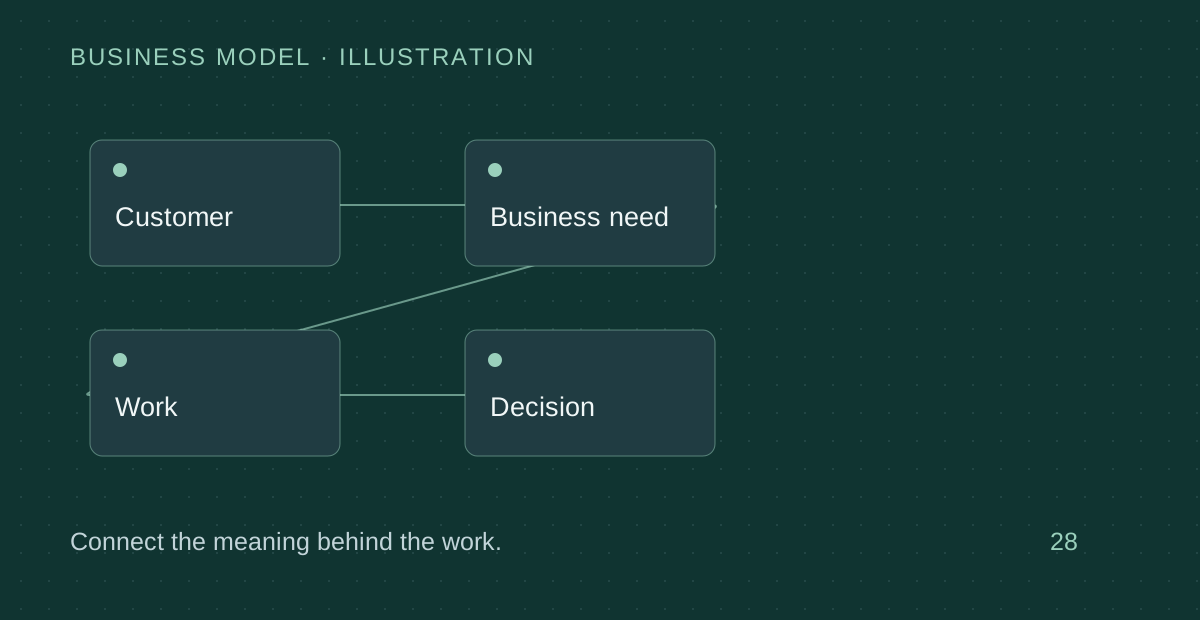
Connect a reusable lesson to the original case, business conditions, decision, reasoning and observed outcome. Keep exceptions and failed approaches alongside successful guidance. Assign a maintainer who can review whether the lesson still applies when the offer, policy or operating environment changes. An AI can retrieve a relevant precedent, but should expose the context needed to judge its applicability. Organizational memory becomes useful when it supports the next responsible action, rather than merely increasing the amount of searchable material.
The decision for your role
For an HR leader, this capability should help describe the capacity of people and agents working together. Record the task family, supervision required, business context and demonstrated result before assigning a capability label. Access to an AI tool does not prove that a person can evaluate its output, and a successful output does not prove that an agent can repeat the work under different conditions. Keep the contribution of the preparer, reviewer and approver distinct. Record correction effort and rejected work as well as accepted results, then use the pattern to design training, support and assignments. Avoid converting every operational observation into an employee ranking. Where comparative evaluation is useful, agree on purpose, comparable work and the chance to correct inaccurate records. A change in tools, policy or context can require reassessment. The aim is a defensible view of organizational capability that supports development and responsible delegation, with the limits of each assessment visible to the people making assignments.
Apply it in the operating setting
In professional services, the scope of a promise often evolves through meetings and follow-up messages. Use one engagement to connect the customer's request, agreed scope, proposal, delivery responsibilities and acceptance evidence. Keep a proposed change distinct from an authorized variation. When AI assists research or drafting, preserve which claims were verified and which still need a subject expert. A delayed engagement can then be understood through missing decisions or dependencies rather than a generic late status. Assess whether the client-facing owner can explain the current commitment without collecting separate updates from every contributor.
The operating discipline
Capability should be assessed against the work a person-and-machine arrangement is expected to perform. Record the task family, relevant context, assistance used and acceptance standard. Avoid treating tool access as evidence of competence or a single successful output as proof of consistent performance. Keep reviewer effort visible: apparent automation may depend on substantial human correction. The goal is to understand reliable capacity, including its limits, so future assignments reflect demonstrated ability. Use the history to improve training, task design and review support rather than turning every observation into a simplistic leaderboard.
A practical decision example
For an unusual client request, preserve why the specialist chose an exception and what happened afterward. A reusable rule can then describe both the normal approach and the circumstances that justify review. If the outcome is unknown, keep that uncertainty visible. A persuasive explanation from a respected specialist is still different from evidence that the advice worked in the conditions of a later case.
Observe, automate and verify responsibly
Before enabling an automatic action, define what the operating history must retain. A useful record identifies the actor, business object, time, reason, authority, relevant input version, observed action and resulting state. Keep a failed attempt separate from a successful retry. If the action sends an email, distinguish preparation, approval, send attempt and delivery observation; attempting to send does not prove that the recipient received or acted on it. Assign an owner for exceptions and say when a human must intervene. Then ask a colleague who was not involved to reconstruct the event using the records alone. Missing context is a model gap to resolve before increasing autonomy. This is how observability supports accountability across people, agents and connected systems, rather than becoming a large collection of unexplained technical logs.
What to test first
Have a colleague resolve a representative case using the captured knowledge. Measure unanswered questions, unsafe generalizations and time needed to find the applicable precedent.
What this means for Flowise
Flowise is designed around a shared company model: business purpose, relationships, ownership, and results. Start with real work, preserve the supporting evidence, and improve the model as the team learns.